
All-trades contractorNice, Monaco & French Riviera — 06
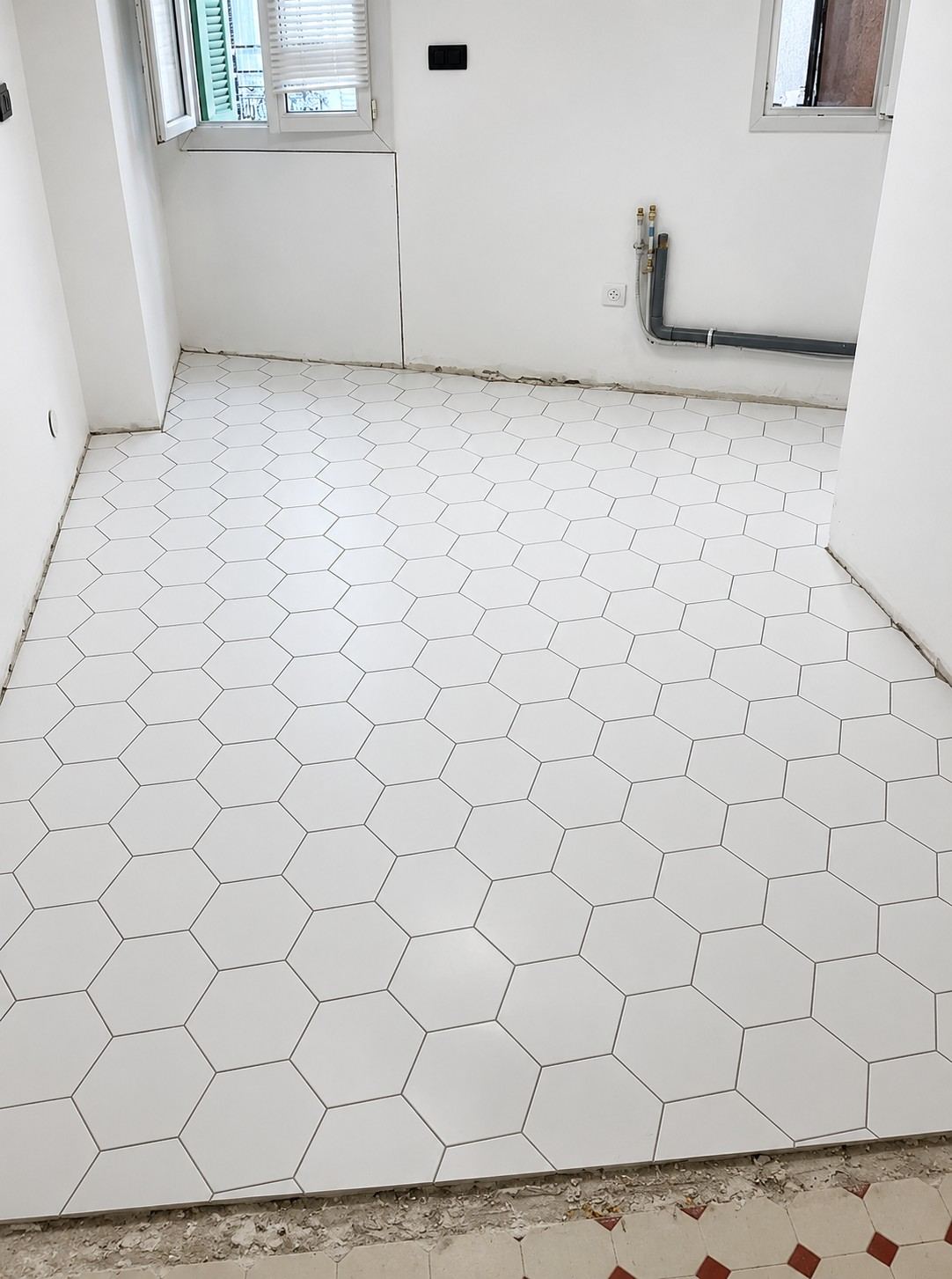
The cut tiles are shared out around the perimeter, the joints fall on the centre line of the openings.

HomeExpertiseFine materials & finishes

Fine materials &finishes

Stone, marble, solid parquet, architectural metalwork. The right materials, laid with the precision of the workshop.

Our approach

The material,

A fine material badly laid is still a material badly laid. Chevron parquet turns on the starting line, large formats on the flatness of the substrate, stone on the direction and gauge of the blocks, marble on matching the veining between two neighbouring slabs.

We choose the materials with you, then prepare the substrates properly — levelling compound, primer, drying time — before laying anything at all. It is the invisible part that decides how it looks.

The materials we work in

  • Natural stone and dressed stone
  • Marble, travertine and marble-grade stone
  • Solid parquet: chevron, herringbone, parquet blocks
  • Large-format porcelain stoneware and material effects
  • Terracotta, encaustic cement tiles and zellige
  • Architectural metalwork: glazed screens, balustrades, handrails
  • Decorative paint, plaster finishes and limewash
  • Plasterwork, mouldings and cornices

The material is not everything: the laying decides

A fine stone badly laid makes a poor floor; a modest material perfectly laid gives a result that holds for twenty years. The difference between the two is not in the supply invoice, it is in the substrate, the setting out and the junctions.

The substrate first: flatness, dryness, a decoupling layer where one is needed. A large-format tile forgives no hollow; a parquet bonded to a screed that is still damp comes away. Then the setting out: it is what decides whether a cut falls in the middle of a doorway or hides under a skirting. And the junctions: where two materials meet is exactly where the eye settles.

Stone, wood, brass, polished concrete: what each one asks for

Natural stone is alive: it has variations, veining, sometimes fossils. It is mixed from several pallets before laying, otherwise the batches show up as patches. Limestone and marble are sensitive to acids — an ordinary limescale remover is enough to mark a basin.

Wood moves with the humidity. It acclimatises in the room before it is laid, and it needs a gap around the edges that the skirting covers. Solid, engineered and laminate are not laid in the same way and are not renovated in the same way.

Brass and the other metals take on a patina: that is what they are there for. A lacquer fixes the colour of the first day, bare metal goes on changing. That choice is made at the start; it cannot be made again later.

Polished concrete and mineral plaster finishes are decorator's finishes applied to a perfect substrate. They correct nothing: every defect underneath comes back through. And they need a surface protection matched to the use, which is not the same in a shower as in a living room.

What ages well on the French Riviera

The local climate adds constraints of its own. Salt and sea air attack certain metals and certain treatments; the sun fades deep colours behind a large window; the alternation of great heat and damp spells makes timber move and tires flexible joints.

None of that rules out a material, it guides the choice: a suitable grade of stainless steel rather than ordinary steel outdoors, a water-repellent treatment on a porous stone, a finish that stands up to ultraviolet on the south side. These are decisions taken at the quotation stage, not after the first summer.

Maintenance: what you are left with

At handover we leave the list of what has been laid: references, finishes, the cleaning products that are compatible and those to avoid. It is a short document, and it is what saves a stone from being killed with limescale remover or a parquet with a soaking mop.

Fine materials do not ask for more maintenance than others: they ask for different maintenance. Knowing which makes the difference between a floor that takes on a patina and a floor that stains.

Step by step

How the work is carried out

01

Visit and survey

Condition of the substrates, flatness, moisture, constraints of use and of exposure.

02

Choice of materials

Samples seen in real light, compatibility checked against the use of the room.

03

Quotation and orders

Quotation within 48 working hours, supply and installation separated. Ordered as soon as it is agreed.

04

Substrate preparation

Levelling compound, decoupling layer, waterproofing, moisture content checked. Nothing is laid on a doubtful substrate.

05

Setting out

Marked out on the floor before laying: the cuts are placed, not suffered. Agreed with you.

06

Laying and handover

Laying, joints, junctions and trims. Handover, snags cleared, maintenance sheet handed over.

How we work

The detail

01

The setting out

We draw the layout before we lay it: starting line, how the cuts are shared out, direction of the light. A sliver of a cut in a visible corner spoils a whole floor.

02

The substrates

Levelling compound, bonding primer, drying times respected. Large formats and solid parquet forgive nothing on flatness.

03

How it ages

We favour materials that improve with age — stone, solid oak, brass — and details that can be put right rather than replaced.

Frequently asked questions

Materials and finishes: your questions

Is natural stone fragile?

It is durable but sensitive to acids: an ordinary limescale remover marks a limestone or a marble. A water- and oil-repellent treatment when it is laid, then cleaning with a pH-neutral soap, is enough. We leave the list of compatible products at handover.

Can a parquet be laid in a bathroom?

Yes, with species that tolerate humidity and a suitable finish, on a sound and ventilated substrate. The critical point is not the water that falls, it is the permanent humidity and what comes up through the perimeter joints.

Is polished concrete suitable for a shower?

It is, provided the waterproofing is done underneath — polished concrete is not a waterproofing system — and provided the surface protection is the one intended for wet rooms, not the one for a living room.

Can I supply the materials myself?

Yes. Before anything is ordered we check that the material suits the substrate and the use, and the quotation separates supply from installation. What you supply stays under your own supply warranty; the installation stays under ours.

How long before the room can be used?

Adhesives, grouts, treatments and lacquers each have their own setting and curing times. The programme allows for them, and at handover we tell you what can be used straight away and what still needs a few days.

We work in Nice, across the Alpes-Maritimes and right along the French Riviera

NiceAntibesSaint-Jean-Cap-FerratBeaulieu-sur-MerCap d'AilValbonneSaint-Paul-de-VenceMentonVenceRoquebrune-Cap-MartinCannesMonacoVillefranche-sur-MerÈzeMouginsSophia-AntipolisCagnes-sur-MerGrasseLe Cannet

For a quote, let's talk

Let's bring to life

Tell us about your project: we will come back to you within 48 hours for a first conversation and a visit to the property.

Call usRequest a quote