
All-trades contractorNice, Monaco & French Riviera — 06
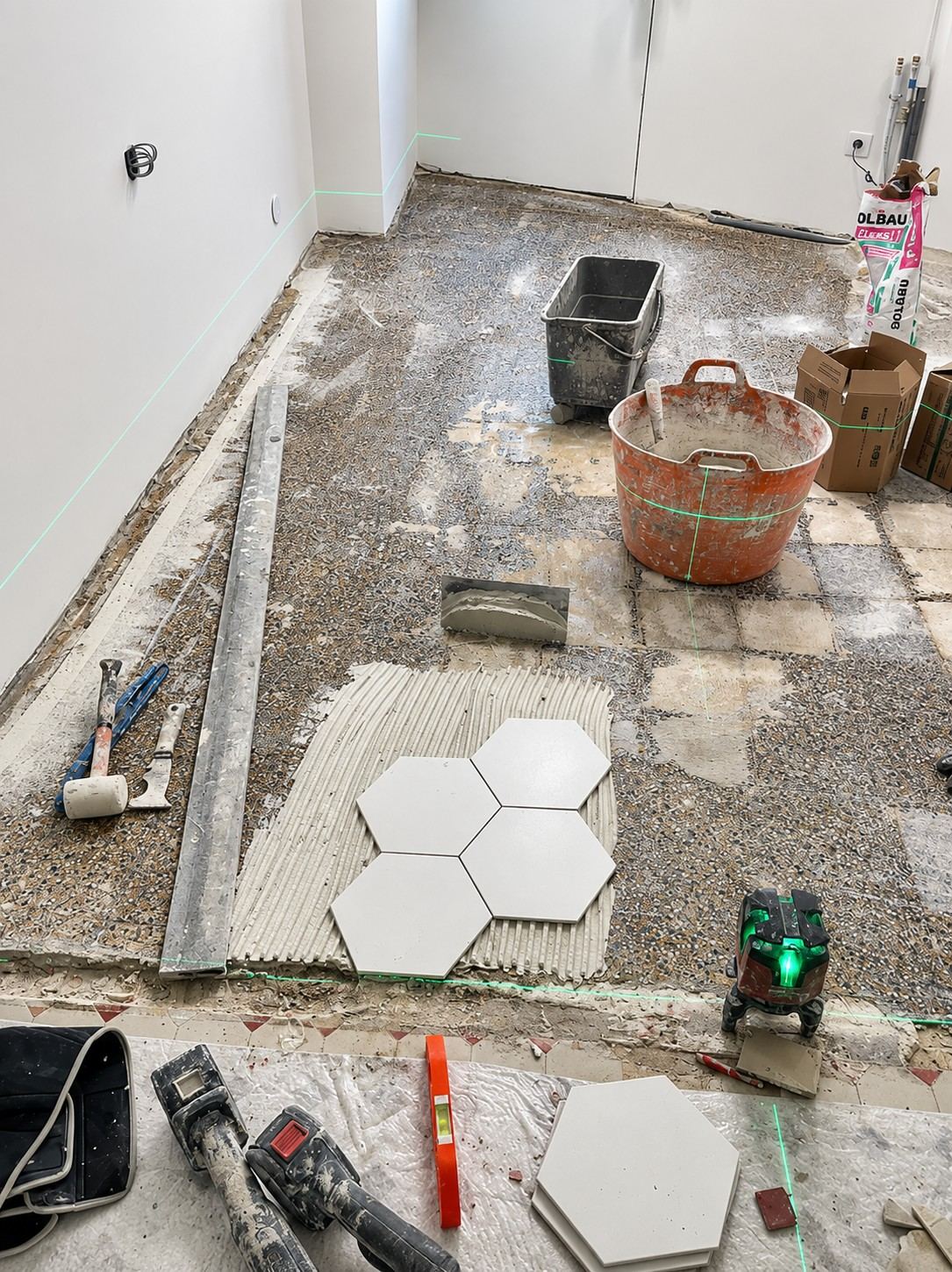
Laser setting out and the first row bedded on combed adhesive: it is this starting line that decides the whole layout.

HomeExpertiseFull renovation

Full

Complete refurbishment of houses, apartments and fine residences. A project held in hand from end to end, from structural work to the final finishes.

Our approach

Taking on a place

Renovating a house or an apartment in full is not a matter of stacking up trades: it is a matter of deciding an order. The strip-out governs the structure, the structure governs the services, the services govern the partitions, and the finishes forgive nothing that was rushed underneath.

That is why we take on the whole project. One person weighs up the priorities, holds the programme and answers for all of it — including what can no longer be seen once the walls are closed.

In a co-owned building, the project has rules of its own: see our page on apartment renovation in Nice.

For a house or a villa — roof, façades, outdoor works — see our page on house and villa renovation in Nice.

What we take on

  • Strip-out, demolition and disposal
  • Structural works and new openings
  • Plumbing, water supply and waste
  • Electrics brought up to regulations
  • Partitions, linings and suspended ceilings
  • Thermal and acoustic insulation
  • Internal and external joinery
  • Floors: tiling, parquet, stone
  • Paint, plaster finishes and detailing
  • Full clean before handover

A full renovation is, first of all, an order

Renovating a home in full is not a sum of separate jobs, it is a chronology. Each trade opens the way for the next and closes the one before it for good. A conduit forgotten before the lining is paid for in chases cut into a new wall; tiling laid before the joinery is paid for in chipped edges. The order is not a site preference, it is what decides the final cost.

That is what an all-trades contractor is for. The same person holds the demolition, the structure, the services, the partitions, the floors and the finishes: nobody waits for anybody, and nobody passes the blame for a defect to the trade next door. You sign one quotation, not seven.

What you find when you open up, in Nice

Period buildings in the centre. Carré d'Or, the Musiciens quarter, Cimiez, Libération: floors on timber joists, brick partitions laid in plaster, lath-and-plaster ceilings. These floors cannot be loaded like a concrete slab, and a partition thought to be light has sometimes ended up carrying the one above. The services are often as old as the building — lead, cast iron, circuits with no earth — and they are renewed while everything is open, never afterwards.

Residences from the 1960s and 70s. Fabron, Mont Boron, northern Nice: concrete structure, thin slabs, shared service risers. Sound insulation becomes a subject as soon as a carpet gives way to a hard floor. The heating is sometimes embedded in the slab, which is not something to drill into blind.

Old Nice and the Port. Thick walls, narrow staircases, access along lanes a lorry cannot enter. Anything visible from outside falls to the Architecte des Bâtiments de France. Removal of rubble and deliveries are arranged before the first blow of the sledgehammer, not on the day.

And in any building whose permit predates July 1997, an asbestos survey is mandatory before floors, adhesives or ducts are taken up. This is not one more formality: it is what decides whether the strip-out takes two days or two weeks.

Timescales: what really decides them

It is almost never the floor area. It is three things. First the administrative delays: a vote at the general meeting to touch a common part, a prior declaration of works, an opinion from the Architecte des Bâtiments de France. Then the lead times: dressed stone, made-to-measure joinery or a limited-run wall tile is ordered when the quotation is signed, not when it is due to be laid. And finally drying: a screed, a plaster coat, a paint impose their own calendar, and forcing it shows in the result.

The programme we issue with the quotation separates these three kinds of delay. You know what depends on us, what depends on a third party and what depends on nobody.

Budget: what moves it

Every item is priced separately. This is not an accounting presentation, it is a tool for making choices: you see what a bathroom costs, what a floor costs, what the joinery costs, and you decide before signing rather than halfway through the works.

Surprises almost always come from what was hidden — a weakened structure, services long past their age, damp of long standing. So we open up what needs opening during the visit, and anything that remains uncertain is written down as such in the quotation rather than discovered along the way.

Step by step

How the work proceeds

01

Visit and survey

We come to see the home, the building and its access. Room measurements, condition of the services, photos.

02

Itemised quotation

Within 48 working hours. Every item is priced separately, with the programme attached.

03

Consents

Managing agent informed, file for the general meeting or a prior declaration of works if needed, common parts protected.

04

Strip-out and structure

Demolition, removal, openings made under propping. What was hidden is dealt with now.

05

Services and partitions

Plumbing, electrics, partitions, linings, suspended ceilings. Everything is checked before closing up.

06

Finishes and handover

Floors, painting, internal joinery, cleaning. Handover with you, snags cleared.

How we work

The detail

01

One person answerable

You coordinate nothing. We tender, plan and decide on your behalf, and we answer for the whole project.

02

A programme that holds

The programme is issued with the quotation, material lead times included. The trades follow on with no dead time.

03

A clean site

Access routes and retained work protected, regular clearance, cleaning at every stage. A site kept in order shows in the result.

Frequently asked questions

Renovating in full: your questions

How long does a full renovation take?

It depends less on the floor area than on the consents, the lead times and the drying times. The programme issued with the quotation separates these three, so you know what can be compressed and what cannot.

Can we live on site during the works?

For one or two rooms, yes: we seal off the work area and keep water and electricity running. For a full renovation it is better to move out — the work goes faster, and you are spared the dust and the shut-offs. If you do not live locally, we run the project without you, with regular photo reports.

Do I need the co-ownership's consent?

Not for work inside your own lot: non-load-bearing partitions, floors, bathroom, kitchen, painting. As soon as the common parts or the outward appearance are affected — load-bearing wall, waste stack, façade — a vote at the general meeting is required. We prepare the technical file for the managing agent.

One quotation for every trade?

Yes. That is what an all-trades contractor is: one quotation, one programme, one person answerable, and no grey area between two trades when a defect appears.

What happens if a problem is found during the works?

We show it to you before touching it, with the cost of putting it right and its effect on the programme. Nothing is added to the invoice without your written agreement.

We work in Nice, across the Alpes-Maritimes and right along the French Riviera

NiceAntibesSaint-Jean-Cap-FerratBeaulieu-sur-MerCap d'AilValbonneSaint-Paul-de-VenceMentonVenceRoquebrune-Cap-MartinCannesMonacoVillefranche-sur-MerÈzeMouginsSophia-AntipolisCagnes-sur-MerGrasseLe Cannet

For a quote, let's talk

Let's bring to life

Tell us about your project: we will come back to you within 48 hours for a first conversation and a visit to the property.

Call usRequest a quote